

interactive coding accessories pack for micro:bit interactive coding accessories pack for micro:bit
micro:bit Interactive Coding Accessories Pack $61.00 ex GST ($67.10 inc GST)
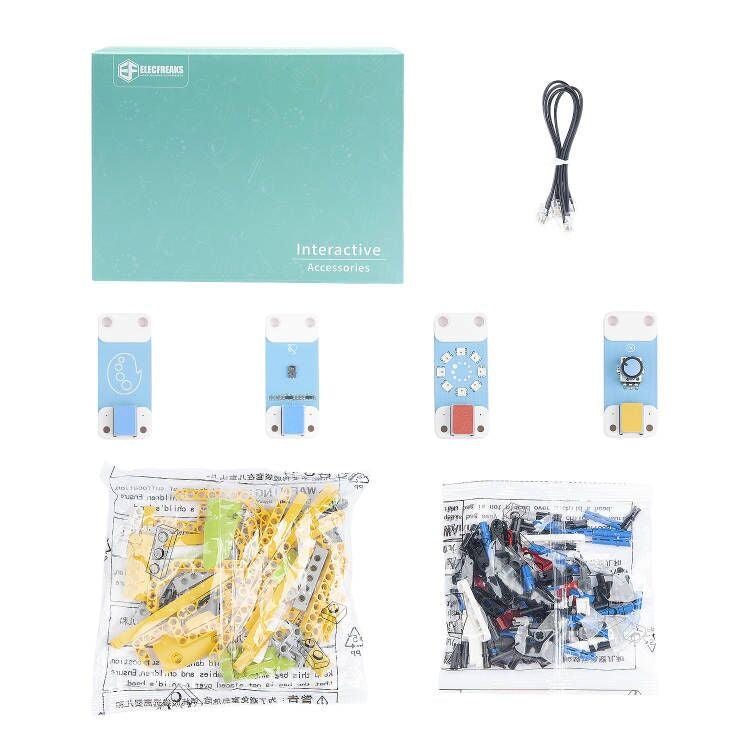
This add-on pack gives an existing Nezha Inventor's Kit or TPBot car a new set of senses. A colour recognition sensor and a gesture sensor let students build projects that respond to what they can see and to a wave of the hand — the point at which coding starts to feel like artificial intelligence rather than switches and timers. What's included: Planet X colour recognition sensor Planet X gesture recognition sensor Planet X NeoPixel light ring Planet X trimpot module Four RJ11 (4P4C) connecting leads Over 180 building bricks micro:bit, TPBot car and Nezha board are not included — this pack expands a kit you already own What students practise: Working with sensors that classify rather than simply measure Mapping an input range to an output using the trimpot Extending a project they have already built, instead of starting over Block coding in MakeCode with the Planet X extension Six documented projects on the ElecFreaks wiki introduce the ideas behind machine perception in terms a primary or lower secondary class can follow.
nezha inventor kit for micro:bit nezha inventor kit for micro:bit
micro:bit Nezha Inventor's Kit — 48-in-1 $195.00 ex GST ($214.50 inc GST)
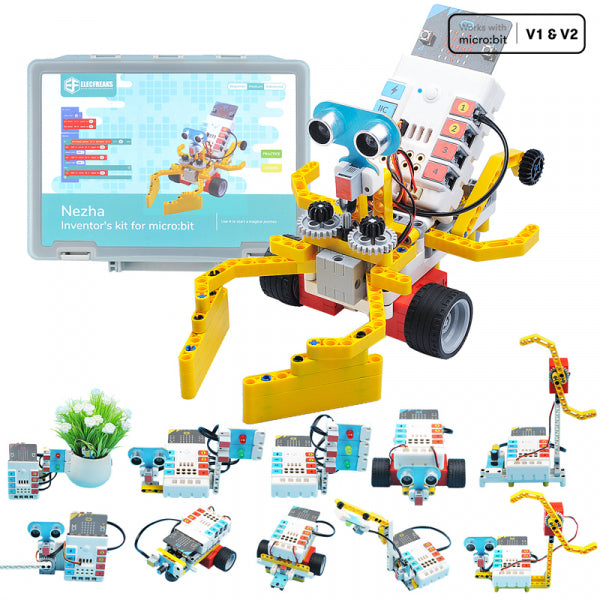
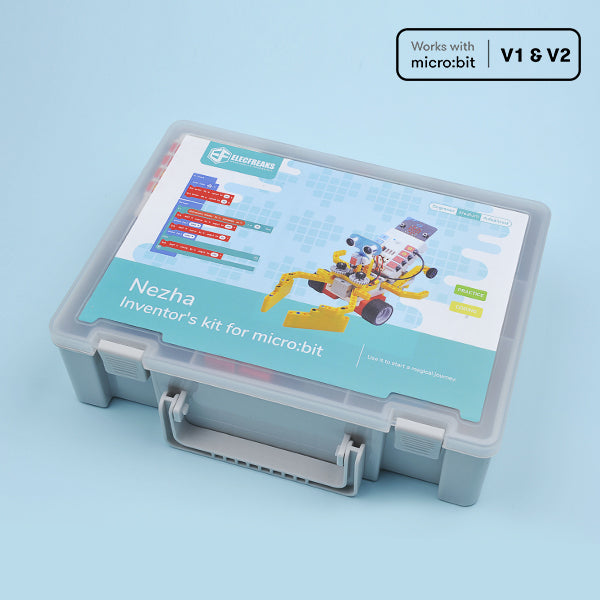
The Nezha Inventor's Kit is the deepest micro:bit kit we stock, and the one that keeps a class busy longest. Forty-eight documented projects — a mechanical shrimp, an automatic gate, a flower-watering prompt, a temperature-controlled fan — each built from bricks and driven by sensors the students wire themselves. What's included: Nezha expansion board for the micro:bit, with colour-coded ports Planet X sensors: ultrasonic, crash, line-tracking, soil moisture and trimpot LED modules, a 360° servo and a motor Over 400 building bricks, compatible with the common brick standard RJ11 connecting leads and a storage case with dividers micro:bit board is not included — add a micro:bit V2 at checkout What students practise: Building a machine to a plan, then modifying it when the plan doesn't survive contact Choosing the right sensor for a problem, out of a box with several options Block coding in MakeCode, with Python and JavaScript available as students progress Working independently — there are enough projects here for a term, not a lesson Sammat's Online Academy carries 36 self-paced lessons for this kit, from traffic lights and automatic gates through to line-tracking and colour recognition cars — sold as an add-on, and included in the classroom pack. The RJ11 connectors are keyed so they can't be plugged in backwards, and the ports carry colour labels matching the sensors: small things that save a great deal of classroom time.
sammat education online academy - nezha inventor kit for micro:bit sammat education online academy - nezha inventor kit for micro:bit
micro:bit Nezha Kit + 36 Academy Lessons $346.00 ex GST ($380.60 inc GST)
Our deepest Academy course, and the one that keeps a child busy longest. The Nezha Inventor's Kit, the Interactive Coding Accessories Pack and a micro:bit V2 board, with thirty-six self-paced lessons in the Sammat Online Academy — enough for a full term rather than a weekend. What's included: 1 x Nezha Inventor's Kit — Nezha expansion board, Planet X sensors (ultrasonic, crash, line-tracking, soil moisture, trimpot), LED modules, a servo and motor, and over 400 building bricks in a divided case 1 x Interactive Coding Accessories Pack — colour recognition sensor, gesture recognition sensor, NeoPixel light ring, trimpot and 180+ bricks 1 x micro:bit GO pack (V2) — board, battery pack with 2 x AAA batteries and a USB cable 36 self-paced lessons in the Sammat Online Academy, with written guides and video walkthroughs The lessons cover: Traffic lights, automatic gates, mini table lamps and an automatic dryer Line-tracking, obstacle-avoiding and speed-adjustable cars Sound projects — a music box, a volume reminder, a memory test Gesture and colour recognition, including a colour recognition password door You will need a computer, phone or tablet with internet access to load the Microsoft MakeCode editor. The RJ11 connectors are keyed so they cannot be plugged in backwards, and the ports carry colour labels matching the sensors — small things that save a lot of frustration.