

micro:bit Cutebot Pro — ElecFreaks Robot Car
$88.00 ex GST
($96.80 inc GST)
Cutebot Pro is the version for students who have outgrown approximate. Its encoder motors are closed-loop, so the car can be told to travel a set distance or turn a set angle and actually do it — which changes the kind of problem you can set. Four line-tracking sensors instead of two mean it can read crossroads and T-junctions rather than a single line.
What's included:
Cutebot Pro car with closed-loop encoder motors and wide-grip tyres
Four-way infrared line-following sensor array
Ultrasonic distance sensor
Two rainbow lights, two headlights, a buzzer and an infrared receiver
Integrated 18650 lithium battery box
micro:bit board is not included — add a micro:bit V2 at checkout
What students practise:
Controlling distance and turning angle precisely, then measuring the error
PID line following, using four sensor readings fused into one value
Block coding in MakeCode, progressing to Python or JavaScript
Competition-style problem solving where accuracy decides the outcome
Please note: the 18650 battery is not included and cannot be shipped with the car under air freight rules. You will need a flat-top 18650 cell (3.7–4.2V) — a button-top cell will not fit. Bluetooth, infrared remote and Joystick:bit control are all supported.
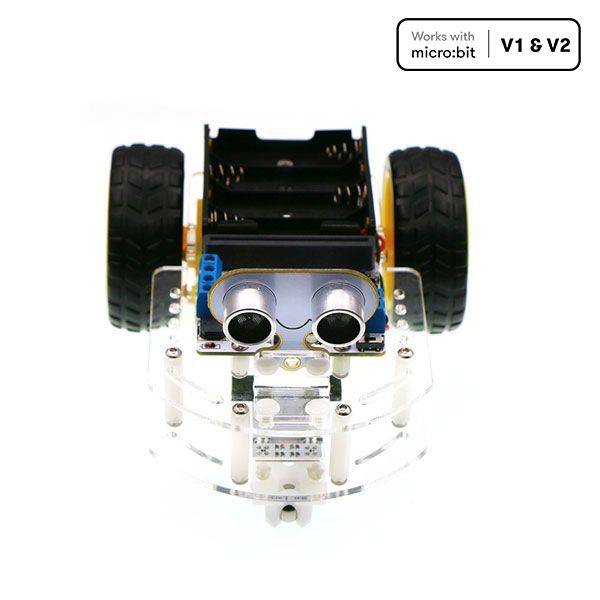
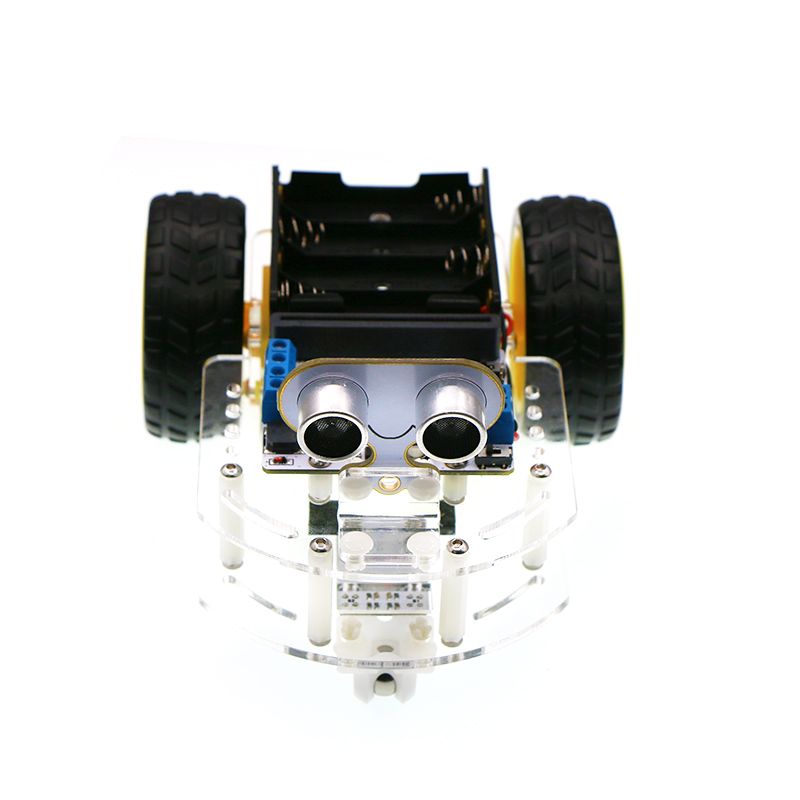
micro:bit motor:bit Smart Car Kit
$50.00 ex GST
$73.77 ex GST ($55.00 inc GST)
The motor:bit Smart Car Kit is a two-wheel robot students build themselves, then teach to see. With an ultrasonic sensor at the front and two line-tracking modules underneath, it can park at a fixed distance, hold its position behind a moving obstacle, or follow a taped line around the classroom floor.
What's included:
motor:bit driver board with a TB6612 chip, 12 GVS ports and an I2C port
sonar:bit ultrasonic distance sensor
Two line-tracking modules
Acrylic chassis and assembly hardware
micro:bit board and batteries are not included — add a micro:bit V2 at checkout
What students practise:
Using sensor input to make a decision, rather than just running a fixed sequence
Threshold thinking — deciding what counts as "too close" or "off the line"
Building and wiring a working machine from parts
Debugging behaviour they can watch happen
Six documented projects on the ElecFreaks wiki take a class from fixed parking through line tracking to Bluetooth remote control, so the same car supports several lessons rather than one.
micro:bit Smart Cutebot — ElecFreaks Robot
$57.00 ex GST
($62.70 inc GST)
Cutebot is the micro:bit robot car most people picture when they think of one. It is small, quick and almost entirely pre-assembled — only the batteries and the ultrasonic sensor need fitting, so a class can be driving within minutes of opening the box rather than at the end of the lesson.
What's included:
Cutebot rear-drive car with dual N20 high-speed motors
HC-SR04+ ultrasonic distance sensor
Large line-following map and user guide
Two RGB LED headlights, two NeoPixel rainbow lights and underbody clearance lamps
Two line-tracking probes, a buzzer horn and an infrared receiver
Runs on 3 x AAA batteries, not included
micro:bit board is not included — add a micro:bit V2 at checkout
What students practise:
Sequencing and speed control — the difference between full speed and gradual
Line following and obstacle avoidance using sensor thresholds
Block coding in MakeCode, progressing to Python, JavaScript or C++
Measuring, adjusting and testing rather than guessing
The arc-shaped shell takes knocks well and the motors are fully enclosed against dust, which matters for a robot that spends its life on classroom floors. A 3-pin port allows sensor expansion, and the body accepts standard building bricks. Measures 85 x 85 x 38 mm.
micro:bit TPBot Smart Car — ElecFreaks
$79.00 ex GST
($86.90 inc GST)
The TPBot works straight out of the box without a micro:bit — it will follow a line and avoid obstacles on its preset modes alone. That matters in a classroom, because a child who is stuck can still see the thing work, then slot in a micro:bit and start changing what it does.
What's included:
TPBot smart car with an ABS shell
Line-tracking map
Sticker sheet and user manual
Runs on 4 x 1.5V dry cell batteries, not included
micro:bit board is not included — add a micro:bit V2 at checkout
What students practise:
Sequencing and steering — getting a robot to follow a planned route
Using sensor input to make a decision instead of running a fixed program
Block coding in Microsoft MakeCode, with Python available for older students
Designing a body for the robot, then testing whether it still drives properly
Lock joints on both sides and studs on the roof take standard building bricks, so the same car becomes a police car, a delivery truck or a football player. Four sensor connections and four servo connections allow expansion, and it works with our Interactive Coding Accessories Pack. Winner of a bronze IDEA Design Award. Measures 113 x 128 x 90 mm.