

Hummingbird Bit Premium Kit — micro:bit Robotics
$453.64 ex GST
($499.00 inc GST)
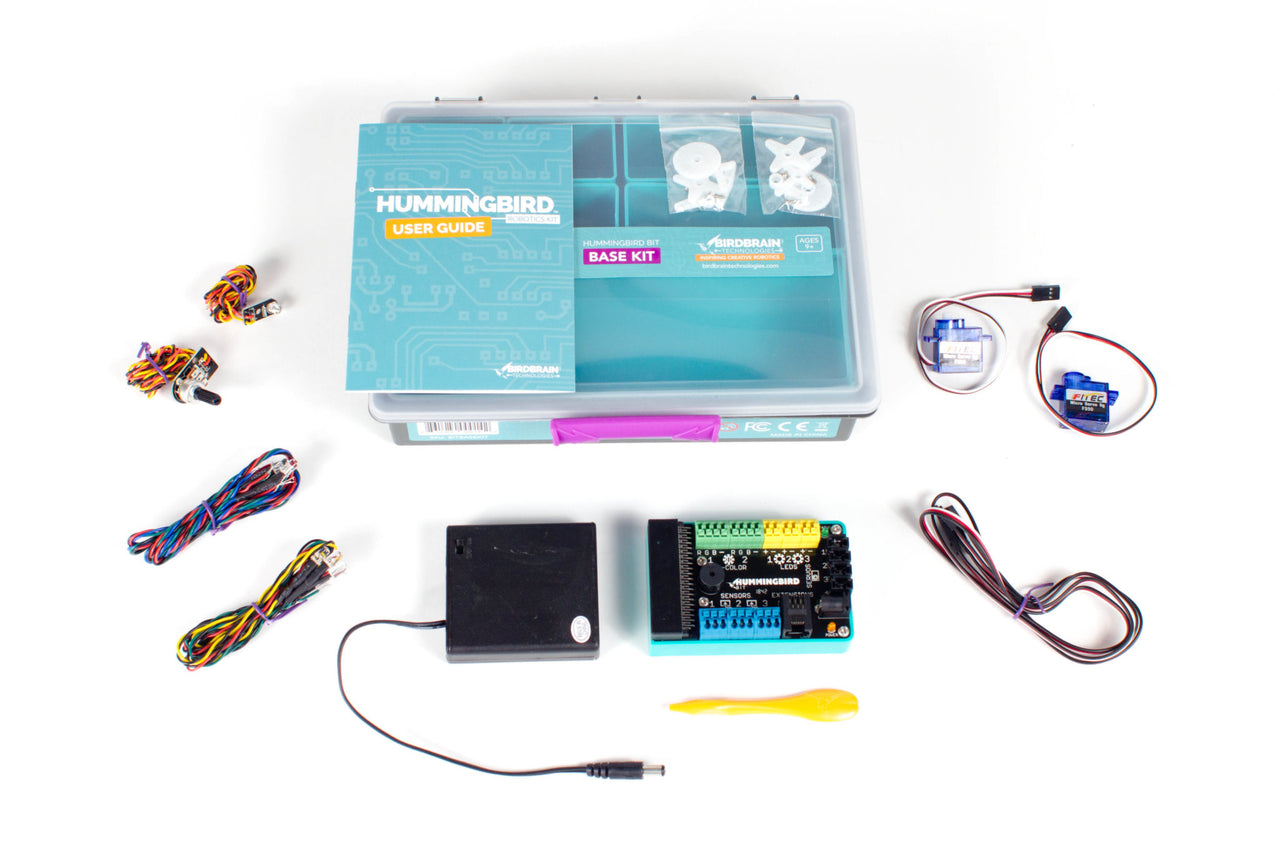
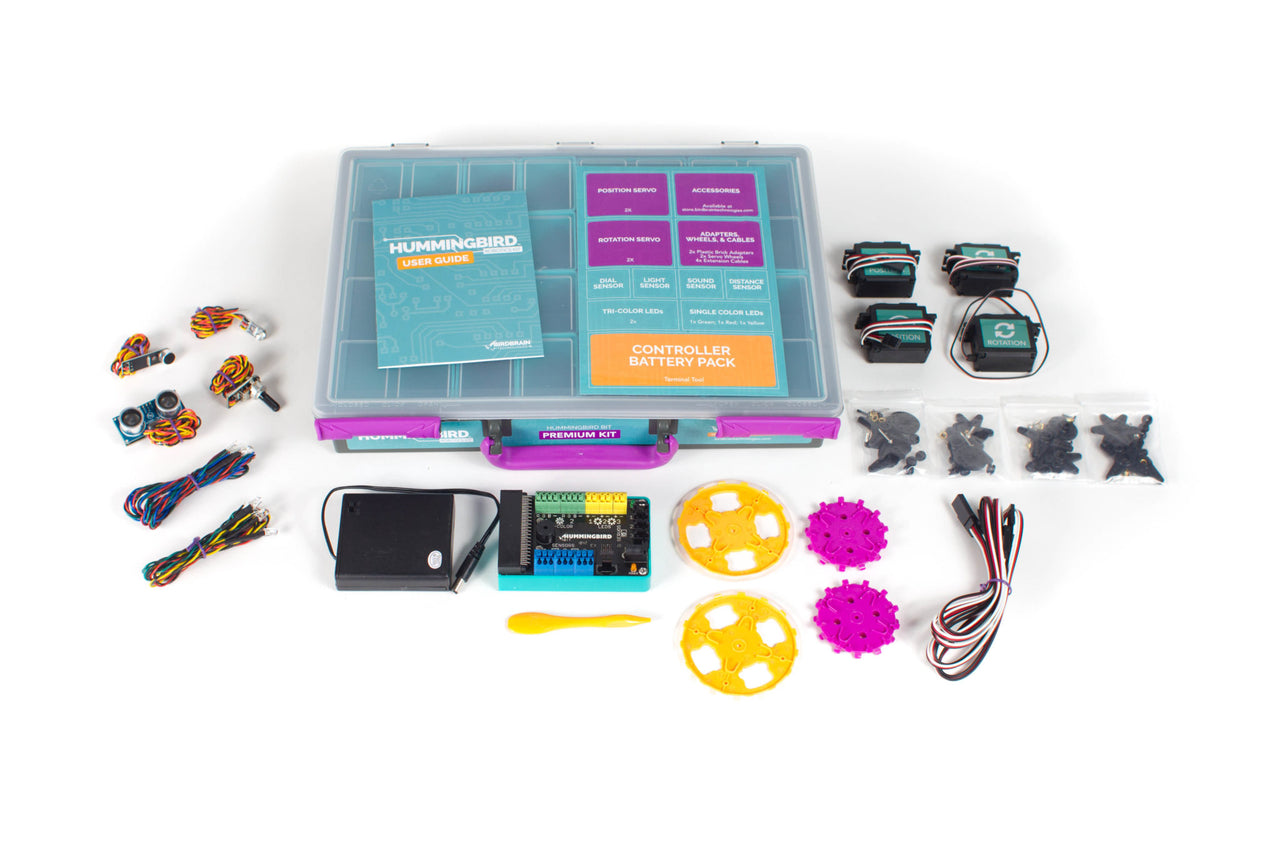
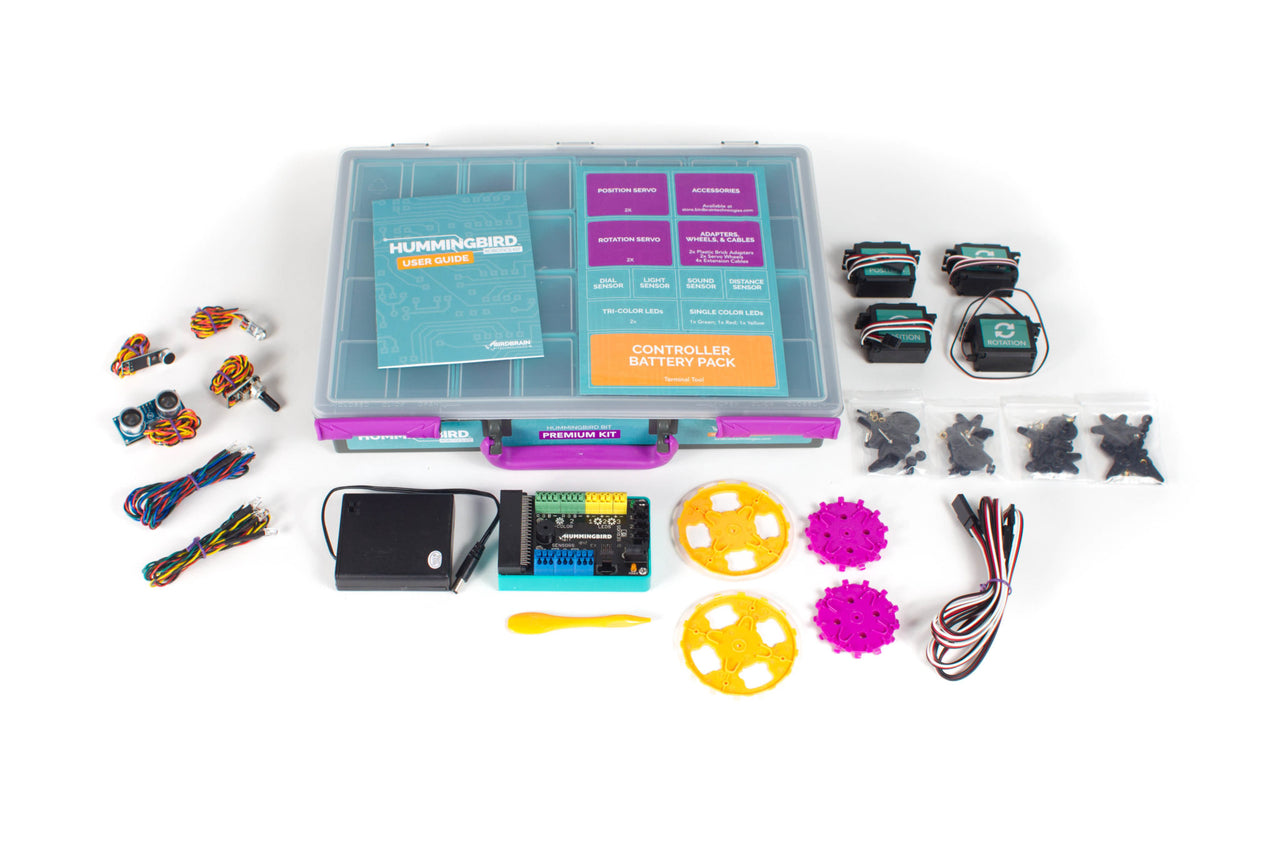
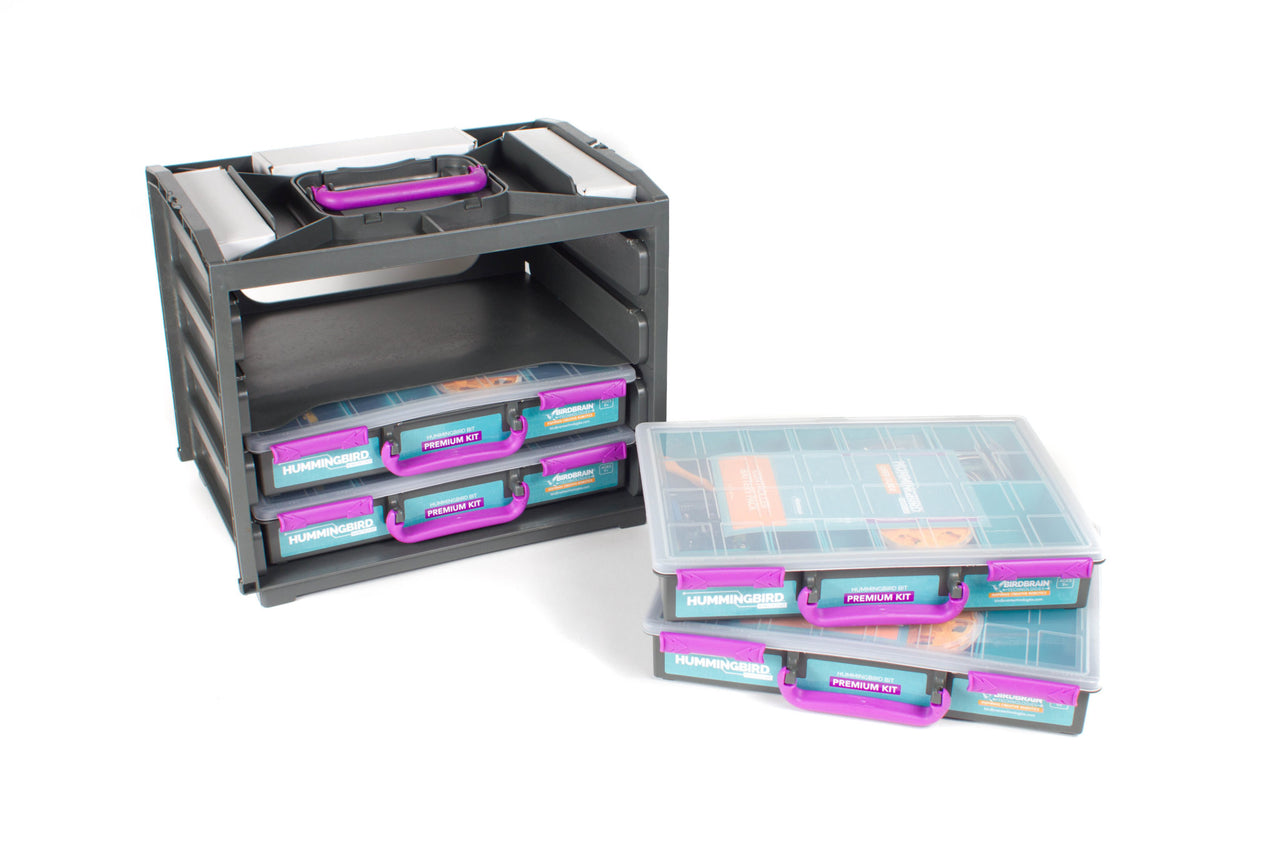
The Hummingbird Bit Premium Kit gives students everything in the Base Kit and more — extra motors, sensors and building parts to design bigger, more capable robots. Combine the electronics with everyday craft materials and code your creation to move, sense and respond using the BBC micro:bit.
What's included (parts for one robot):
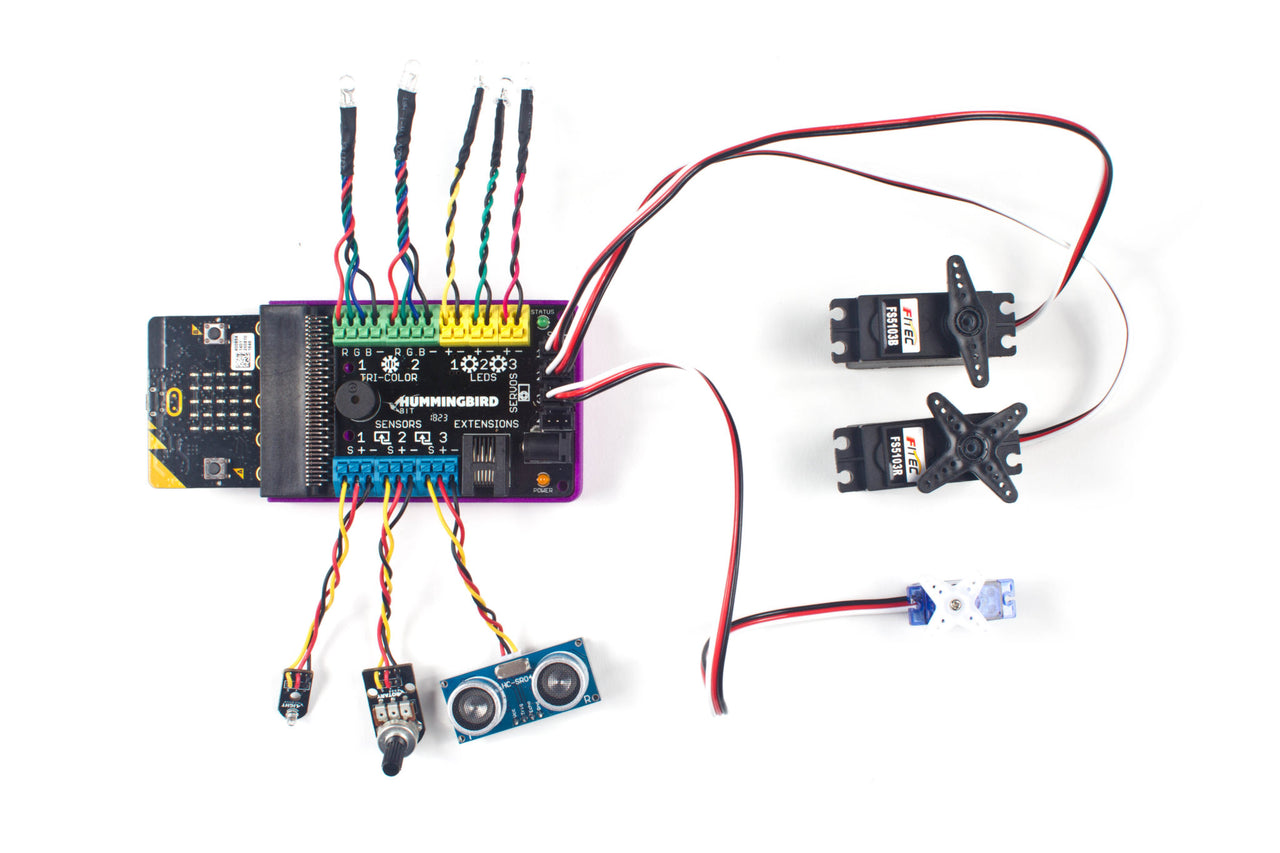
1 × Bit Controller (the robot's brain), 1 × terminal tool and 1 × 4×AA battery holder
1 × green, 1 × red and 1 × yellow single-colour LED, plus 2 × tri-colour LEDs
2 × position servos and 2 × rotation servos, with 2 × servo wheels and 2 × plastic block (brick) adapters
4 × servo extension cables
1 × light sensor, 1 × dial sensor, 1 × distance sensor and 1 × sound sensor
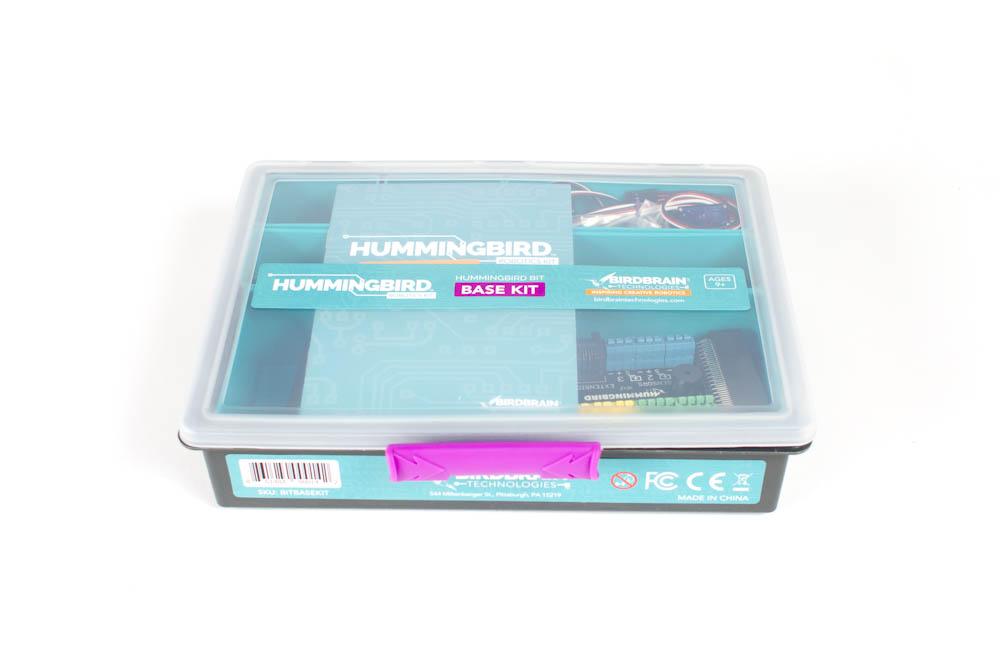
User manual and a sturdy storage case
What students practise:
Designing and building more advanced robots and moving models
Coding in block-based or text-based languages, including MakeCode, Python and Java
Using distance and sound sensors so robots respond to their surroundings
Adding wheels and brick adapters to build driving and mechanical projects
Electrically protected connectors let students add parts freely without damaging them. Free, classroom-tested lesson plans and coding tutorials are included. A BBC micro:bit is required as the controller's brain — choose the option with a micro:bit and USB cable at checkout, or supply your own. AA batteries not included (4 needed).
New to Hummingbird? The Base Kit is a simpler starting point. Kitting out a class? The Hummingbird Starter Flock bundles four Premium Kits with classroom tools, or see the full Hummingbird range.
Hummingbird Dial Sensor (Knob)
$12.68 ex GST
($13.95 inc GST)
The Hummingbird dial sensor is a rotary knob students turn to send a changing value to their code — like a volume dial. Use it to control a robot's speed, brightness or sound, and to explore how inputs drive outputs. Fits any Hummingbird Bit Controller port.
For directional input instead, see the Hummingbird Joystick. Browse all Hummingbird parts.
Hummingbird Distance Sensor
$34.50 ex GST
($37.95 inc GST)
The Hummingbird distance sensor measures how far away the nearest object is, so robots can avoid obstacles, stop before a wall or react as something approaches. A key part for building rovers and autonomous projects. Fits any Hummingbird Bit Controller port.
It comes in the Hummingbird Bit Premium Kit. See the full Hummingbird range.
Hummingbird FS90 Micro Servo
$13.59 ex GST
($14.95 inc GST)
The FS90 micro servo is a small motor that moves to a precise angle on command — ideal for lightweight moving parts like flapping wings, turning heads or waving arms. A handy spare or add-on for your Hummingbird robot.
It's included in the Hummingbird Bit Base Kit. Need a stronger motor? See the Position Servo.
Hummingbird Joystick
$26.32 ex GST
($28.95 inc GST)
The Hummingbird joystick gives students two-axis directional control to feed into their code — perfect for steering a robot, moving a character on the micro:bit display, or driving a game. Connects to the Hummingbird Bit Controller.
For a single-axis dial instead, see the Hummingbird Dial Sensor. Browse all Hummingbird parts.
Hummingbird Light Sensor
$12.68 ex GST
($13.95 inc GST)
The Hummingbird light sensor measures how bright or dark it is, so students can code robots that react to light — switching on a lamp at dusk, following a torch, or triggering an alarm when a drawer opens. Fits any Hummingbird Bit Controller port.
It's included in the Hummingbird Bit Base Kit. Explore the full Hummingbird range.
Hummingbird Position Servo (FS5103B)
$31.77 ex GST
($34.95 inc GST)
The FS5103B position servo is a standard-size motor that turns to a precise angle you set in code — with more strength than the micro servo for larger moving builds. Program exact positions to open, lift, turn or point. Fits any Hummingbird Bit Controller port.
Need continuous spin for wheels instead? See the Rotation Servo. Both come in the Premium Kit.
Hummingbird Rotation Servo (FS5103R)
$34.50 ex GST
($37.95 inc GST)
The FS5103R rotation servo spins continuously in either direction at a speed you control in code — the motor to choose for wheels and driving robots. Pair it with a Hummingbird servo wheel to get your creation rolling. Fits any Hummingbird Bit Controller port.
Add a Hummingbird Servo Wheel to drive it, or step up to angled control with the Position Servo.
Hummingbird Servo Brick Adapter
$9.95 ex GST
($10.95 inc GST)
This adapter connects a Hummingbird servo to plastic building bricks, so students can attach motors to LEGO®-compatible builds and combine robotics with construction play. A simple way to bridge coding and hands-on making.
Browse all Hummingbird kits and parts.
Hummingbird Servo Extension Cable
$11.77 ex GST
($12.95 inc GST)
This extension cable adds reach between a Hummingbird servo and the Bit Controller, so students can mount moving parts further from the robot's brain. Handy for taller or wider builds. Buy spares for busy classrooms.
Browse all Hummingbird parts, or start with a complete Base Kit.
Hummingbird Servo Wheel
$9.95 ex GST
($10.95 inc GST)
This wheel clicks onto a Hummingbird rotation servo to turn a spinning motor into a driving robot. Buy a pair to build a rover, buggy or any project that needs to roll. Designed to fit the FS5103R rotation servo.
You'll need a Hummingbird Rotation Servo to drive it. Browse all Hummingbird parts.
Hummingbird Single Colour LED
$9.05 ex GST
($9.96 inc GST)
Add a bright point of light to any robot with a Hummingbird single-colour LED. Program it to turn on, off or flash to signal, decorate or bring a build to life. Available in green, orange, red and yellow, and connects to any Hummingbird Bit Controller port.
Want colour-changing light? See the Hummingbird Tri-colour LED, or browse all Hummingbird parts.
Hummingbird Sound Sensor
$19.95 ex GST
($21.95 inc GST)
The Hummingbird sound sensor measures how loud the surroundings are, so students can build robots that respond to sound — clap to start, react to noise, or run a simple sound-level meter. Fits any Hummingbird Bit Controller port.
It comes in the Hummingbird Bit Premium Kit. Browse all Hummingbird parts.
Hummingbird Starter Flock — 4 Premium Kits
$1,726.36 ex GST
($1,899.00 inc GST)
The Hummingbird Starter Flock is a ready-made class set for micro:bit robotics, with parts for a group of 8–12 students to build robots together. It brings together four Hummingbird Bit Premium Kits with shared classroom tools and storage, so a teacher can run a full robotics unit straight out of the box.
What's included:
4 × Hummingbird Bit Premium Kits (parts to build 4 robots)
4 × screwdrivers and 2 × wire strippers for the class
1 × carrying case to store and transport the set
Each Premium Kit contains a Bit Controller, motors (position and rotation servos with wheels and brick adapters), a full sensor set (light, dial, distance and sound), single- and tri-colour LEDs, cables and a case.
What students practise:
Collaborating in small groups to design and build robots
Coding in block-based or text-based languages, including MakeCode, Python and Java
Engineering, wiring and problem-solving with real components
Free, classroom-tested lesson plans, coding tutorials and online teacher professional learning are included. A BBC micro:bit is required for each robot (choose the option with micro:bits and USB cables, or supply your own). AA batteries not included (16 needed). Australian owned with purchase orders welcome from schools.
Just need one kit? Start with the Hummingbird Bit Premium Kit or the Base Kit. Browse all Hummingbird robotics kits.
Hummingbird Terminal Tool
$9.05 ex GST
($9.96 inc GST)
The Hummingbird Terminal Tool is the small tool used to loosen and tighten the screw terminals on the Hummingbird Bit Controller, making it easy to connect and swap LEDs, sensors and motors. A handy spare for classrooms where tools tend to wander.
Building or restocking a kit? See the Hummingbird Bit Base Kit or all Hummingbird parts.
Hummingbird Tri-colour LED
$13.59 ex GST
($14.95 inc GST)
The Hummingbird tri-colour LED mixes red, green and blue light to create any colour you can code. Perfect for mood lighting, status signals and eye-catching robot builds. Connects to any Hummingbird Bit Controller port.
Prefer a fixed colour? See the Hummingbird Single Colour LED, or browse all Hummingbird parts.
Hummingbird Vernier BTA Adapter
$21.77 ex GST
($23.95 inc GST)
This adapter connects Vernier BTA-style probes to a Hummingbird Bit Controller, opening up science data-logging projects — temperature, force and more — alongside your robotics builds. Bridges coding, robotics and science experiments.
Browse all Hummingbird kits and parts.
indi STEAM Program
Take your whole class on the road to STEAM learning with the indi STEAM Program. indi is our entry-level robot designed to introduce early learners to computational thinking, STEAM, and computer science principles.
Ink2Go
from $21.27 ex GST
($23.40 inc GST)
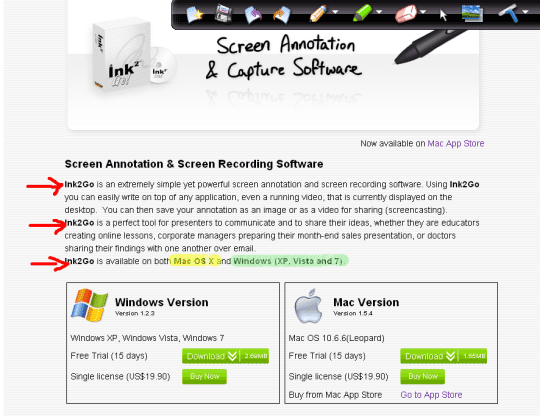
Ink2Go is an extremely simple yet powerful screen annotation and recording software. You can easily write on top of any other application that is currently active on the desktop, even on a running video. You can then save your annotations as an image file or even record the whole session as a video for sharing. It is a useful tool for presenters to communicate and share ideas during a live session, for educators to create effective video tutorials and for salespeople to create impressive video presentations. Ink2Go is available for both Windows (XP, Vista and 7) and Mac OS X 10.6.6 (Leopard) or later, Intel only.
Invent To Learn: Making, Tinkering, and Engineering in the Classroom
$40.86 ex GST
($44.95 inc GST)
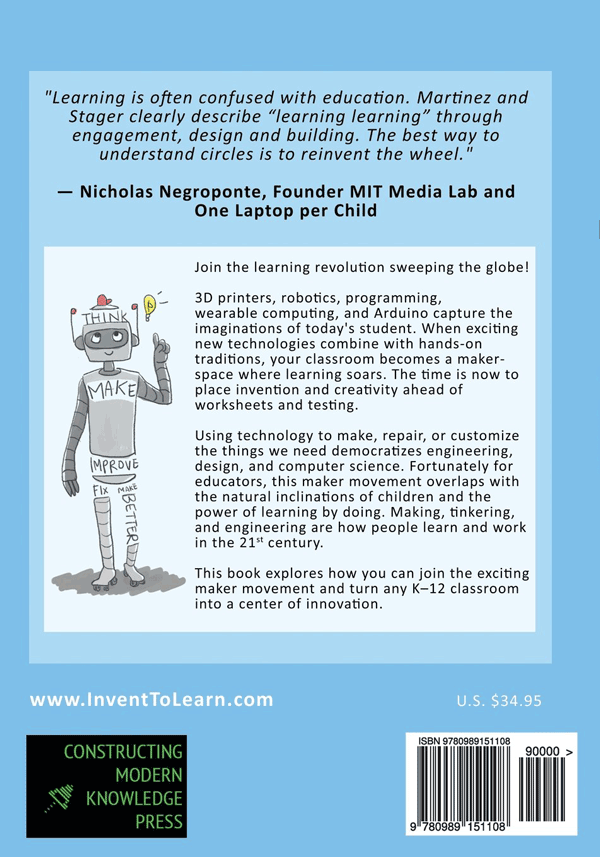
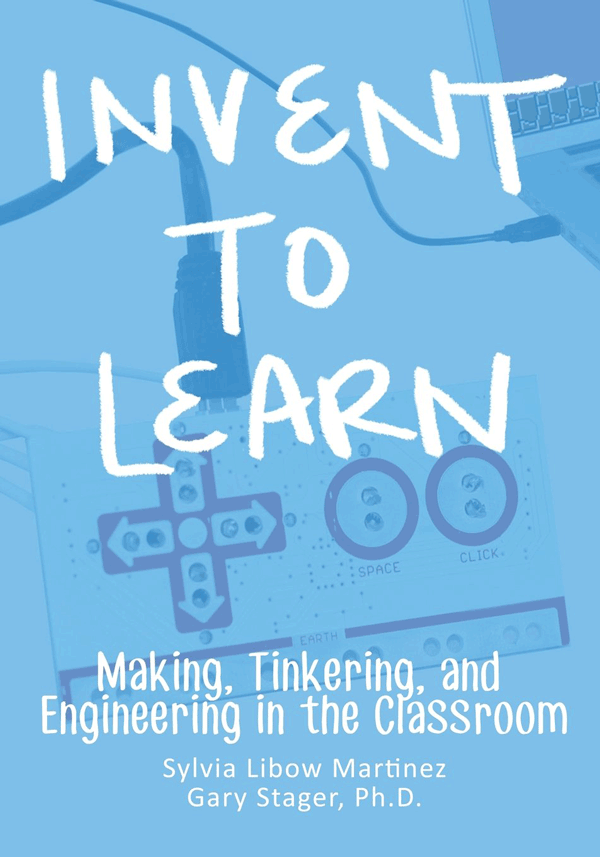
Invent To Learn: Making, Tinkering, and Engineering in the Classroom - Join the maker movement!
There’s a technological and creative revolution underway. Amazing new tools, materials and skills turn us all into makers. Using technology to make, repair or customise the things we need brings engineering, design and computer science to the masses. Fortunately for educators, this maker movement overlaps with the natural inclinations of children and the power of learning by doing. The active learner is at the centre of the learning process, amplifying the best traditions of progressive education. This book helps educators bring the exciting opportunities of the maker movement to every classroom.
Children are natural tinkerers
Their seminal learning experiences come through direct experience with materials. Digital fabrication, such as 3D printing and physical computing, including Arduino, MaKey MaKey and Raspberry Pi, expands a child’s toy and toolboxes with new ways to make things and new things to make. For the first time ever, childhood inventions may be printed, programmed or imbued with interactivity. Recycled materials can be brought back to life. While school traditionally separates art and science, theory and practice, such divisions are artificial. The real world just doesn’t work that way! Architects are artists. Craftsmen deal in aesthetics, tradition and mathematical precision. Video game developers rely on computer science. Engineering and industrial design are inseparable. The finest scientists are often accomplished musicians.
The maker community brings children, hobbyists and professionals together in a glorious celebration of personal expression with a modern flare. When 3-D printing, precision cutting, microcomputer control, robotics and computer programming become integral to the art studio, auto shop or physics lab, every student needs access to tools, knowledge and problem solving skills. The maker movement not only blurs the artificial boundaries between subject areas, it erases distinctions between art and science while most importantly obliterating the crippling practice of tracking students in academic pursuits or vocational training. There are now multiple pathways to learning what we have always taught and things to do that were unimaginable just a few years ago.
Making for every classroom budget
Even if you don’t have access to expensive (but increasingly affordable) hardware, every classroom can become a makerspace where kids and teachers learn together through direct experience with an assortment of high and low-tech materials. The potential range, breadth, power, complexity and beauty of projects has never been greater thanks to the amazing new tools, materials, ingenuity and playfulness you will encounter in this book. In this practical guide, Sylvia Martinez and Gary Stager provide K-12 educators with the how, why, and cool stuff that supports classroom making.
Jumper Wires
$5.54 ex GST
($6.09 inc GST)
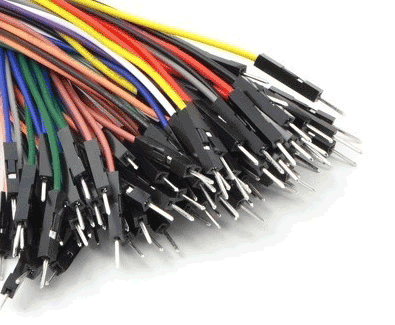
Jumper Wires - 40 Pack - 10 Piece assorted colours. Spare Jumper wires are useful in MaKey MaKey, Arduino and other electronics projects.
Junior Explorers STEAM Program
Welcome to our Junior Explorers STEAM Adventure, where little minds meet big discoveries! Designed for preschoolers aged 4-6, this exciting program invites young learners to embark on a journey of creativity and exploration. Through playful interaction with Bee Bots and Sphero Indi, children will learn the basics of coding and problem-solving in a fun, hands-on environment. Our engaging activities are crafted to spark curiosity and foster a love for learning, setting the foundation for future innovation and discovery. Join us as we transform learning into an exhilarating adventure for your little one!
K-6 STEAM Program
The K-6 STEAM Program is a term based STEAM program that lasts for an 8 week term. It allows for 4 classes of students to participate in 8 x 1 hour sessions based around STEAM principles such as coding and programming as well as several design and invention challenges.
KaiBits Large Sensor Pack — 28 Sensors
$198.66 ex GST
($218.53 inc GST)
KaiBits are the sensors that turn a KaiLab coding lesson into a data lesson. Students collect real readings from the room around them — soil moisture, temperature, light — and watch those readings change the virtual world on screen in real time. A digital tree grows as the soil moisture reading rises.
What's included:
1 x KaiBit Large Sensor Pack containing 28 IoT sensors
What students build:
Interactive projects combining sensor inputs with outputs
Automation — code that responds to a condition rather than a button press
Environmental science investigations grounded in their own measurements
What students practise:
Data collection, and the messiness of real readings against clean textbook numbers
Cause and effect between the physical and virtual environments
The IoT concepts underpinning smart buildings, agriculture and environmental monitoring
This is the large pack, matching the sensor set supplied with the KaiLab 12-robot classroom pack. Requires KaiLab robots and the KaiLab platform, sold separately.
KaiBot Advanced Coding Cards — 100 Pack
$63.99 ex GST
($70.39 inc GST)
The Advanced Coding Cards take KaiBot well past forwards, backwards and turn. This pack of over 100 cards covers movement, logic, functions, repeats, conditionals, variables, colour and social-emotional prompts — enough to keep a student progressing for years without moving to a screen.
What's included:
1 x pack of 100+ advanced coding cards
Durable, water-resistant finish built for daily classroom handling
What the cards cover:
Movement and directional control
Logic, conditionals and repeats
Functions and variables — concepts most primary students meet first on a screen
Colour commands and social-emotional prompts
Why it matters:
The whole algorithm sits on the desk where a class can see it, point at it and argue about it
Debugging becomes physical — students swap a card rather than hunt through code
Concepts transfer directly to Blockly and Python when students move on
The cards were designed by computer science teachers and are scaffolded by difficulty, so one pack serves a mixed-ability group rather than only the students who are already confident. Requires a KaiBot robot, sold separately. Multiple packs are worth considering for a class — each group coding at once needs its own deck.
KaiBot Autonomous Charging Dock
$69.00 ex GST
($75.90 inc GST)
The Autonomous Charging Dock lets KaiBot look after its own battery. Paired with Kainundrum, the robot drives itself over to the dock and charges when it needs to — no one has to remember to plug it in at the end of a lesson.
What's included:
1 x charging dock
1 x magnetic charge tile
1 x magnetic USB charge cable
How it fits your setup:
The charge tile works alongside standard KaiTiles, so the dock sits inside a maze rather than beside it
Multiple docks can be linked together for a charging row
The magnetic connector means no fiddly plug for small hands to find
This dock is optional — KaiBot also charges from its own USB cable, included with the robot. It earns its place where robots are in constant use and a flat battery costs you a lesson, or where self-charging is itself the thing you want students to see working. Requires a KaiBot robot, sold separately.
KaiBot Braille Coding Cards — Double Pack
$137.60 ex GST
($151.36 inc GST)
The Braille Coding Cards let students who are blind or have low vision code KaiBot independently — not with a modified version of the lesson, but with the same robot, the same maze and the same algorithm as everyone else at the table. Each card carries its command in Braille and in tactile form, so a student reads the sequence by touch and lays it out themselves.
What's included:
1 x double pack of 100+ Braille coding cards
Why it works in a mixed classroom:
KaiBot reads Braille cards exactly as it reads the standard set, so groups can work together without splitting the activity
The robot's movement gives immediate, non-visual feedback — a student hears and follows the outcome of their own code
Algorithms are understood through touch rather than translated by a support teacher
What students practise:
Braille literacy alongside computational thinking
Sequencing, debugging and spatial reasoning
Independent participation in mainstream coding lessons
Kai's Education developed its accessible range in partnership with the American Printing House for the Blind. Requires a KaiBot robot, sold separately.
KaiBot Charging Case — 10 Robots
$455.00 ex GST
($500.50 inc GST)
The KaiBot Charging Case holds and charges ten robots at once from a single wall socket. It is the answer to the most tedious problem in a classroom robotics set — ten robots, ten cables, and a trolley drawer that never quite gets plugged in before the next lesson.
What's included:
1 x powered charging case (robots not included)
10 x charge docks
10 x USB charge dock cables
1 x multi-port mains USB adapter
Why it earns its place:
All ten robots charge simultaneously, so a set is ready for period one rather than half-flat
Everything travels together — robots, docks and cables stay in one case between rooms
One power point instead of ten, which matters in a classroom with three spare sockets
It pairs naturally with the Medium and Large Classroom Packs, where keeping ten or fifteen robots charged is otherwise a daily job for someone. Robots are not included — this is the case, docks, cables and power supply only.
KaiBot Dragon of Disengagement Game
$275.00 ex GST
($302.50 inc GST)
The Dragon of Disengagement is a board game and comic-book adventure for Years 4 to 6, built around the habits that actually decide whether a student learns: focus, impulse control, flexible thinking and knowing when to ask for help. KaiBot plays the characters Marshie and Marsha, navigating an island of wizards, tricksters and the dragon itself.
What's included:
9 x magnetic game tiles that snap together to form the island board
1 x comic book following Marshie and Marsha's story
50 x question cards, 25 x challenge cards and 24 x magic cards
60 x health tokens
1 x user guide
What students practise:
Attention, emotional regulation and impulse control, framed as gameplay rather than instruction
Empathy, teamwork and digital citizenship through choose-your-path challenges
Coding missions that keep computational thinking in play alongside the SEL work
The question cards are aligned to the CASEL framework, and the game was developed alongside school psychologists — useful if you need to justify it to a curriculum coordinator rather than just a class.
Compatible with KaiBot only. The robot and a set of advanced coding cards are required and sold separately. A free companion app extends the game for classes that want the hybrid version.
KaiBot First Steps in Coding — 10 eBooks
$152.38 ex GST
($167.62 inc GST)
The student activity book that accompanies First Steps in Coding, supplied as a bundle of ten eBooks so each child in a group has their own copy to work through rather than sharing a projected page.
What you receive:
A bundle of 10 student activity eBooks
Delivered digitally — an end-user email address is required to issue access
What students work through:
Activities that pair with the teacher e-resource lesson by lesson
Mathematical thinking applied to coding problems
Game-based tasks students complete alongside a KaiBot robot
Ordering for a class:
Each bundle covers ten students — order enough bundles for your cohort
A class of 25 needs three bundles
The teacher e-resource is a separate purchase and is needed to run the programme
This is a digital product, so nothing ships. Access is issued to the email address supplied with your order. Designed to be used with a KaiBot robot and coding cards, sold separately.
KaiBot First Steps in Coding — E-Resource
$55.42 ex GST
($60.96 inc GST)
First Steps in Coding is a downloadable teaching resource that introduces coding through mathematical thinking and game-based learning, rather than treating it as a separate subject that has to be squeezed into an already full week.
What you receive:
A downloadable e-resource book with teacher notes and student worksheets
Delivered digitally — an end-user email address is required to issue access
What it covers:
Coding concepts introduced through mathematical reasoning
Game-based activities designed to run with a KaiBot robot
Worksheets for students alongside guidance for the teacher
Worth knowing before you order:
This is the teacher edition — for a class set of student activity books, order the 10-eBook bundle separately
It is already included in the KaiBot Small, Medium and Large Classroom Packs, so check before buying it twice
This is a digital product, so nothing ships. Access is issued to the email address supplied with your order. Designed to be used with a KaiBot robot and coding cards, sold separately.
KaiBot Hybrid Coding Robot — Ages 5–15
$199.00 ex GST
($218.90 inc GST)
KaiBot is a hybrid coding robot for students aged 5 to 15 — one robot that works completely screen-free, or alongside a tablet or laptop when you're ready for it. Students lay out a sequence of tactile coding cards, KaiBot reads them with its downward-facing camera, and then drives the sequence out on the floor. The logic is visible on the desk before anyone opens an app.
What's included:
1 x KaiBot robot with built-in rechargeable lithium-ion battery
1 x USB charging cable
1 x set of basic coding cards (33 cards) with a durable, water-resistant finish
How it works:
A downward-facing camera reads the coding cards and senses which numbered KaiTile the robot is sitting on
A 1" LCD screen shows the recorded card, the battery level, and the student's emoji when paired with Kainundrum
Four RGB LEDs signal the robot's state and the student's profile colour
A built-in speaker gives audio feedback during activities
The roof is Lego-compatible, so students can build on top of the robot
Connects over Bluetooth and works with iPad, Chromebook, PC and Mac
What students practise:
Sequencing and debugging, before any syntax gets in the way
A clear progression from unplugged cards to Blockly, and then to Python
Cross-curricular work through Literacy Kitchen, Market Math and Kainundrum
The battery is sealed and the shell has no user-serviceable parts inside, so there is nothing loose for students to mislay. Add the optional Autonomous Charging Dock and, once paired with Kainundrum, KaiBot will drive over and charge itself between lessons.